Proudly serving Phoenix, Scottsdale, Mesa, Chandler, Gilbert, Tempe & surrounding areasCall or Text 24/7: 480-264-9663
Aerial view of a residential neighborhood with saguaros and desert foothills in Phoenix, AZ.

Garage Floor Epoxy Installation and Residential Coatings in Phoenix, AZ

Phoenix Epoxy Co. installs garage floor epoxy coatings for homeowners and businesses across Phoenix, Arizona. Our services include straight epoxy resin flooring, polyaspartic floor coatings, and flake or metallic epoxy finishes built around how each space is used. We also provide residential, commercial, and industrial epoxy flooring along with concrete polishing, staining, and grind-and-seal finishes.

Phoenix heat can push exposed concrete well past 140 degrees, so direct sun, hot tires, and slab expansion quickly expose weak coating systems. We diamond grind each slab to an ICRI CSP 3-5 profile instead of relying on acid etching, then match the coating build to vehicle traffic, UV exposure, and the condition of the concrete. Our crews carry Arizona Registrar of Contractors licensing, follow ADEQ guidance for low-VOC materials, and use ASTM D4541 pull-off testing to verify adhesion.

Every project begins with an in-person slab assessment so the written quote reflects square footage, cracks, moisture, oil saturation, and any coating that must be removed. We explain the tradeoffs among epoxy, polyaspartic, flake, and metallic systems before recommending an option.

Phoenix Epoxy Co. installs garage floor epoxy in Phoenix, Scottsdale, Tempe, Chandler, Gilbert, Glendale, and the broader Maricopa County metro area.

★ ★ ★ ★ ★4.9/5 Average Rating · 20+ Years of Experience · Thousands of Customers Helped · Licensed & Insured · Residential & Commercial

Garage Coating Options & Benefits

What Is Garage Floor Epoxy?

Garage floor epoxy is a resin coating that cures into a protective film over prepared concrete. The finished surface locks down concrete dust and spalling while standing up to foot traffic, vehicle loads, and common chemical spills better than bare concrete.

The bond depends on mechanical preparation, not surface tension. Diamond grinding opens the concrete pore structure so the coating can key into the slab; paint, sealer, and weak existing coatings must be removed first.

Many retail kits contain under 50 percent solids, so much of the rolled material evaporates instead of becoming the wear layer. Our commercial-grade systems use 100 percent solids epoxy where specified, with moisture testing and mechanical prep that thin paint-on kits typically omit.

Benefits of Professional Garage Floor Coatings

The right coating build improves how a garage looks, cleans, and performs without treating every slab as identical. System selection can balance durability, UV stability, cure speed, texture, and design against the actual condition and use of the floor.

  • Locks down concrete dust and surface spalling
  • Handles daily foot traffic and vehicle loads
  • Creates a wear layer for common chemical spills
  • Adds UV resistance with a polyaspartic topcoat
  • Hides tire marks and tool drops with flake blends
  • Reflects ambient and overhead garage lighting
  • Supports slip-resistant texture where needed
  • Offers solid-color, flake, and metallic design choices
Garage Flooring Services

Garage Floor Coating Services

We tailor each coating to the slab, traffic, sunlight, and finish the customer wants. Our experience spans 1970s original slabs and brand-new construction from Ahwatukee to Sun City, where the preparation can change more than the coating itself.

Garage Floor Epoxy Coatings

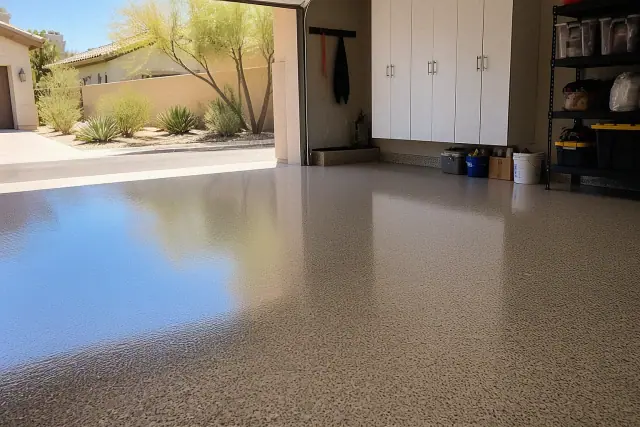
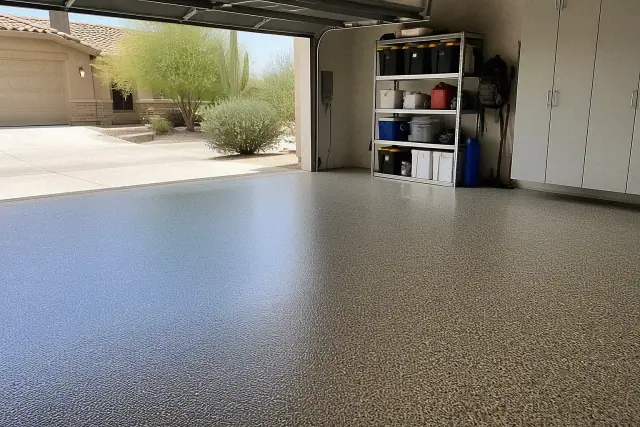
Finished epoxy garage floor with desert landscaping visible through the open door in Phoenix, AZ.

Straight epoxy offers a thick, high-build surface and a lower material cost than faster-curing alternatives. We use commercial-grade resin, mechanical preparation, and the coat count appropriate for daily parking, workshops, or home gyms.

Request Estimate

Polyaspartic Floor Coatings

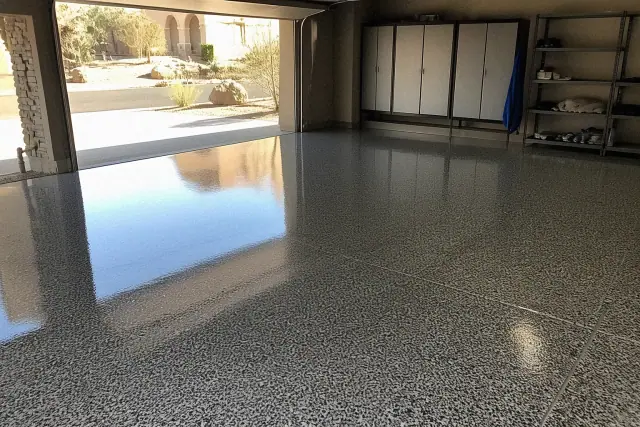
High-gloss polyaspartic garage floor coating in a residential home in Phoenix, AZ.

Polyaspartic and polyurea formulations use aliphatic resins that resist UV yellowing better than aromatic epoxy. They also cure faster, making them useful as topcoats for sun-exposed Phoenix garages and spaces that need a shorter return-to-service window.

Request Estimate

Epoxy Flake Flooring

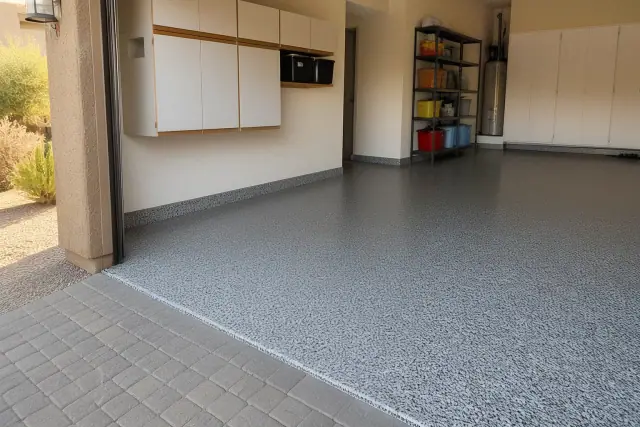
Finished epoxy flake garage flooring in a residential home in Phoenix, AZ.

Flake flooring adds color chips to the coating build so tire marks, tool drops, and everyday wear are less visible than on a solid tint. Customers can choose from dozens of chip combinations, including neutral grays and higher-contrast showroom blends.

Request Estimate

Metallic Epoxy Flooring

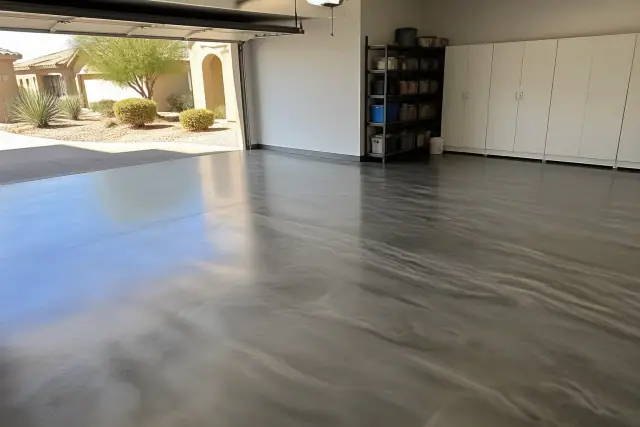
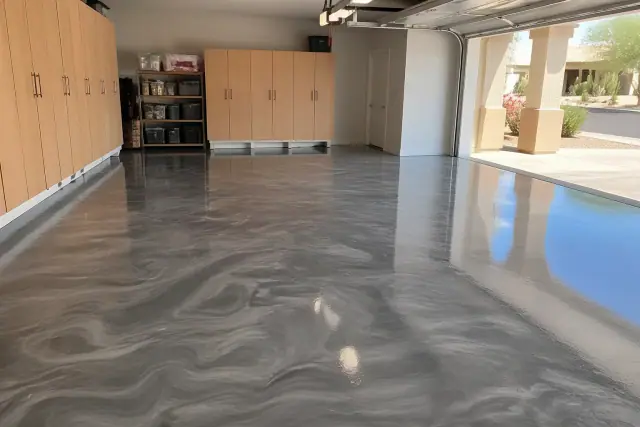
Metallic epoxy garage flooring with a pearlescent texture in a residential home in Phoenix, AZ.

Metallic pigments suspended in clear epoxy create a three-dimensional, poured-stone or moving-water effect as they settle during cure. No two metallic floors are identical, and the reflective surface can brighten garages with limited natural light.

Request Estimate

Commercial & Industrial Epoxy Flooring

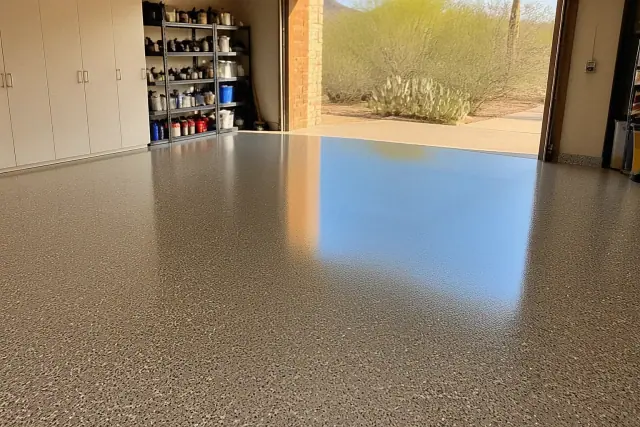
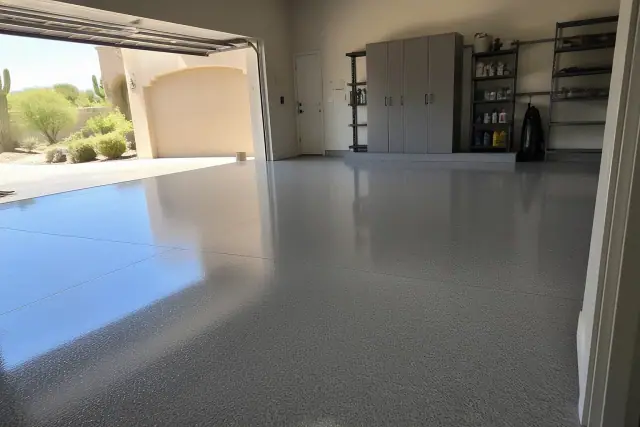
High-gloss epoxy flake flooring inside a residential garage in Phoenix, AZ, with a view of a cactus through the open door.

We specify heavy-duty epoxy and polyurea for warehouses, auto shops, manufacturing floors, retail spaces, restaurants, and other high-traffic facilities. Commercial work can include moisture testing, joint filling, slip-resistant additives, MAG standard details, the engineer of record's load requirements, and applicable OSHA walking-working surface requirements; fast-curing polyurea may allow overnight return to service.

Request Estimate

Concrete Polishing, Staining & Grind-and-Seal

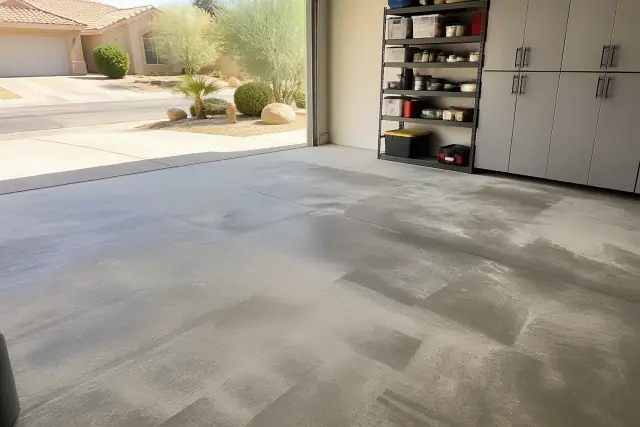
Concrete grinding progress on a residential garage floor in Phoenix, AZ, with visible dust and construction equipment.

For spaces where a resin coating is not the preferred finish, we also provide concrete polishing, concrete staining, and grind-and-seal finishes. The choice depends on the slab's condition, the desired appearance, and how the floor will be used.

Request Estimate
Coating Builds

Types of Garage Floor Coating Options

Solid epoxy, light flake, full-broadcast flake, metallic, and hybrid epoxy-polyaspartic builds each solve a different mix of budget, appearance, sunlight, traffic, and cure-time needs. We review those tradeoffs after assessing the slab instead of defaulting to the least expensive system.

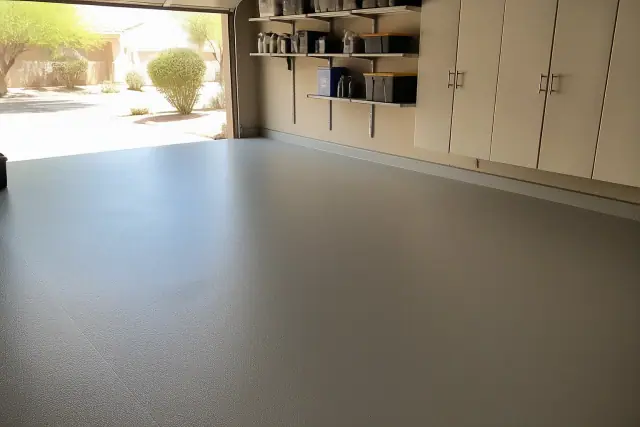
Smooth solid-color epoxy floor in a residential garage with storage cabinets in Phoenix, AZ.

Solid-Color Epoxy

A solid-color system provides a clean, uniform finish with the thicker build epoxy is known for. It works best when the slab is properly ground and the selected topcoat fits the garage's sunlight and traffic.

  • Commercial-grade 100 percent solids epoxy where specified
  • Uniform color without a broadcast chip pattern
  • Thicker build than many fast-curing coatings
  • Lower material cost than polyaspartic-only builds
  • Optional hybrid build for improved UV stability
Request Estimate
Light Flake Systems application on a garage floor in Phoenix, AZ with desert landscaping visible in the background.

Light Flake Systems

A light flake build uses a base coat, a partial or full single broadcast of color chips, and one topcoat. It offers a durable, budget-conscious step up from bare concrete or painted floors.

  • Helps disguise tire marks and daily wear
  • Available in dozens of chip color combinations
  • Coordinates with garage lighting and nearby finishes
  • Suitable for daily parking, workshops, or home gyms
  • Topcoat selected for traffic and UV exposure
Request Estimate
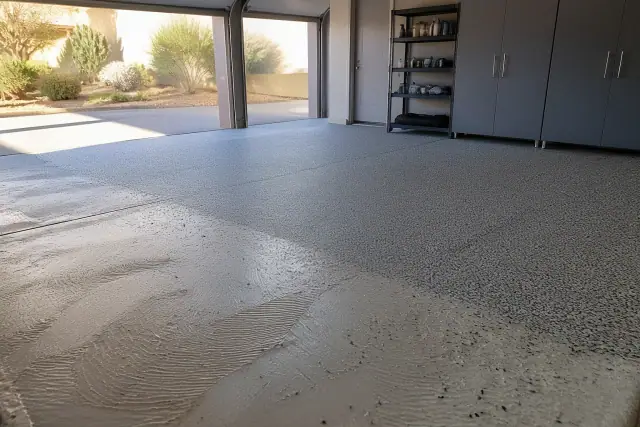
Full-broadcast Granitex epoxy floor in a residential garage in Phoenix, AZ, showing multi-colored flake texture.

Full-Broadcast Granitex Systems

Our four-coat Granitex build combines a primer, base coat, full flake broadcast to rejection, and polyaspartic topcoat. The thicker system is designed for garages that see regular vehicle and foot traffic.

  • Primer establishes the first prepared-slab bond
  • Base coat sets the foundation color
  • Full flake saturation builds coverage and texture
  • Polyaspartic topcoat adds UV resistance
  • Slip-resistant finish supports busy garage use
Request Estimate
Metallic epoxy garage floor in a Phoenix, AZ home with storage cabinets and desert landscaping visible outside.

Metallic Epoxy

Metallic epoxy is the premium design option for garages, showrooms, and entryways that call for depth instead of a flat painted appearance. It is often paired with a clear polyaspartic coat for added scratch resistance.

  • Three-dimensional swirls created during cure
  • Poured-stone or moving-water appearance
  • Unique pattern on every completed floor
  • Reflects ambient and overhead light
  • Used in custom garages around Arcadia and Paradise Valley-adjacent areas
Request Estimate
High-gloss epoxy floor in a residential garage in Phoenix, AZ, with utility cabinets and desert views.

Hybrid Epoxy-Polyaspartic Systems

A hybrid system uses epoxy for build and adhesion, then adds a polyaspartic topcoat for UV stability and faster cure. This approach combines the strongest practical attributes of both coating families for many Phoenix garages.

  • Epoxy base coat provides thickness and adhesion
  • Polyaspartic topcoat resists ambering in direct sun
  • Fast-curing layers set in hours rather than days
  • The floor may be walkable the same day
  • Vehicles typically return in 24 to 72 hours instead of a week-long epoxy cure
Request Estimate
Finding the Right Fit

Choosing the Right Garage Floor Coating Approach

The right system depends on the slab, budget, design goal, traffic, chemical exposure, and how much direct sun enters the garage. A typical two-car garage is 400 to 500 square feet, but identical footprints can need different prep and coating thickness when one is a daily parking area and another is a workshop or gym.

Diamond-Ground Surface Preparation

We mechanically grind the slab rather than depending on acid etching. The resulting open-pore profile gives epoxy a surface it can key into and helps prevent the sheet-like peeling that can appear within a year or two when preparation is inadequate.

Phoenix Heat and UV System Selection

We account for garage-door orientation, direct sun, thermal cycling, hot tires, and the intended cure window before specifying the coating. A UV-stable polyaspartic topcoat is especially useful for west- or south-facing garages where aromatic epoxy can amber.

Testing and Documented Standards

Our process combines slab moisture evaluation with adhesion verification before coating materials are opened. Arizona Registrar of Contractors licensing, ADEQ low-VOC guidance, and ASTM D4541 pull-off testing provide a defined framework for the work rather than a paint-and-hope approach.

What Sets the Installation Apart

Why Choose Us for Garage Floor Epoxy Installation

A coating lasts only as long as its bond to the slab. Phoenix Epoxy Co. evaluates the concrete in person, explains the material and prep tradeoffs plainly, specifies commercial-grade layers for the actual use of the space, and completes a final walkthrough before considering the project finished.

Request Slab Assessment

UV Yellowing and Ambering

Standard aromatic epoxy can yellow under direct UV exposure, especially near an open west- or south-facing garage door. The wrong straight-epoxy system may show ambering within eighteen months, while color drift after two or three Phoenix summers is a common complaint on older installations.

Peeling and Delamination

Coatings applied over a closed, contaminated, or weak surface can peel away in sheets. Acid-etched floors are a frequent delamination problem we encounter on repair calls, which is why we mechanically grind to expose sound concrete.

Hot-Tire Lifting

A coating that is too thin, undercured, or poorly bonded may soften or lift beneath hot tires. Correct film thickness, full cure time, and a coating build selected for daily vehicle traffic reduce that risk.

Cracks, Dust and Spalling

Bare garage slabs can become dusty, stained, cracked, or spalled as they age. We grind back to sound material and patch cracks and damaged areas with a compatible epoxy filler before the coating layers go down.

Moisture Vapor Pressure

Moisture trapped beneath a nonbreathing coating can break its bond to the slab. On older homes without a known vapor-barrier history, we use calcium chloride or relative-humidity moisture testing to identify that risk before installation.

Oil Saturation and Old Coatings

Oil-soaked concrete, paint, and existing sealers interfere with a new coating bond. Mechanical removal and additional grinding add labor, but coating over a compromised layer is a shortcut that can cause early failure.

How It Works

Our Garage Floor Epoxy Process

Every project moves from slab evaluation through mechanical preparation, repairs, testing, coating, cure, and a final walkthrough. The exact materials and coat count change with the selected system, but the bond-building steps do not.

01.

On-Site Slab Assessment

We measure the floor, inspect cracks and spalling, note oil saturation or old coatings, and discuss traffic, sunlight, design, and downtime. That assessment becomes the basis for a written, slab-specific quote.

02.

Coating Removal and Diamond Grinding

Existing paint, sealer, and poorly bonded material are removed mechanically. We then diamond grind the exposed slab to the specified ICRI CSP 3-5 profile so the new resin can key into open concrete.

03.

Crack and Spall Repair

Cracks, chipped edges, and spalled areas are opened, cleaned, and patched with a compatible epoxy filler. This creates a sounder, more uniform surface before primer or base coat application.

04.

Moisture and Adhesion Testing

Where vapor-barrier history is unknown, we evaluate moisture with calcium chloride or relative-humidity testing. ASTM D4541 pull-off testing is used to verify adhesion before the coating kit is opened.

05.

System Application

We apply the primer, base, color or flake broadcast, and topcoat required by the chosen system. Coat count, thickness, texture additive, and topcoat chemistry are matched to the floor's traffic, sunlight, and finish.

06.

Cure and Final Walkthrough

After the coating cures, we inspect the finished surface and complete a walkthrough. Polyaspartic systems cure in hours rather than days, may be walked on the same day, and typically allow vehicles back in 24 to 72 hours; traditional epoxy may require a week-long cure.

Start with Your Slab

Schedule Your Garage Floor Epoxy Estimate

Tell us how you use the garage and what you want the finished floor to look like. We will inspect the concrete, explain which prep and coating build fit the space, and prepare a written estimate based on actual square footage and slab condition.

Garage Coating Help

Garage Floor Epoxy FAQs

Compare pricing, preparation, coating types, cure times, durability, and design considerations before choosing a garage floor system for your Phoenix property.

Call Phoenix Epoxy Co.

Most Phoenix homeowners pay between $1,200 and $3,500, depending on the system, square footage, coating thickness, and prep condition. Standard single-color or light flake systems commonly range from $1,200 to $2,400, while full flake or upgraded polyaspartic systems commonly range from $2,500 to $3,500. We provide a written quote after inspecting the slab.

A 20x20 garage is 400 square feet. A properly prepared standard or light flake system generally ranges from $1,600 to $2,800 installed, while metallic epoxy commonly ranges from $4,000 to $7,000 because of its material volume and application demands. Existing paint, sealer, cracks, or moisture issues can change the final price.

A typical two-car garage is 400 to 500 square feet, and average installed pricing in Phoenix runs from $1,200 to $3,500. Solid-color and standard flake builds sit toward the lower end, while full-broadcast, polyaspartic, or metallic upgrades move higher. Slab preparation often affects the quote more than square footage alone.

Standard epoxy can yellow under UV exposure, may be slippery when wet without texture, and can lift beneath hot tires if it is undercured or poorly bonded. Most early peeling comes from inadequate prep or coating over old paint and sealer. Mechanical grinding, proper cure time, texture where needed, and a polyaspartic topcoat address those risks.

With proper concrete preparation and a polyaspartic topcoat, residential epoxy floors in Phoenix commonly last 15 to 20 years or longer under normal use and basic maintenance. Heavy vehicle traffic or chemical exposure may shorten that lifespan. Poorly prepared coatings can fail within a few years regardless of the coating brand.

Polyaspartic is better at UV stability and cure speed, while epoxy provides thicker build and a lower material cost. Many Phoenix garages benefit from a hybrid epoxy base with a polyaspartic topcoat. That build supports adhesion and thickness while reducing yellowing and shortening the return-to-service window.

No new coating should depend on paint, sealer, or another weak layer for its bond. We mechanically remove existing material and diamond grind the concrete before applying epoxy. The extra prep can be the difference between a floor that lasts two decades and one that fails in two years.

Diamond grinding creates the open concrete profile epoxy needs for a mechanical bond and allows the installer to target an ICRI CSP 3-5 surface. Acid etching may leave a weaker or inconsistent profile, especially where paint, sealer, oil, or dense concrete interferes. Inadequate profiles are a leading cause of sheet-like delamination.

A light flake system uses a base coat, a partial or full single chip broadcast, and one topcoat for a durable, budget-conscious finish. The four-coat Granitex system adds primer, base, full flake saturation to rejection, and a polyaspartic topcoat. That thicker build is suited to garages with regular vehicle and foot traffic.

A polyaspartic or polyurea topcoat is the preferred finish where direct sunlight enters through a west- or south-facing garage door. Its aliphatic resin chemistry resists UV ambering better than standard aromatic epoxy. An epoxy base can still provide build and adhesion beneath that UV-stable topcoat.

Cracks and spalled areas can often be prepared and patched before coating. We diamond grind to sound concrete, then use a compatible epoxy filler on damaged areas before the primer or base coat goes down. The slab assessment determines how much repair work is required.

Commercial-grade epoxy and polyurea systems can be specified for forklifts, chemical exposure, and continuous traffic in warehouses, auto shops, and manufacturing spaces. The build may include moisture testing, joint filling, and a slip-resistant additive. Load requirements and applicable facility standards guide the final specification.

Options include solid colors, dozens of flake chip combinations, and metallic epoxy with three-dimensional depth. Flake blends help disguise tire marks and everyday wear, while metallic pigments create a unique pattern and reflect more ambient light. The best choice depends on lighting, adjoining finishes, traffic, and budget.