Proudly serving Phoenix, Scottsdale, Mesa, Chandler, Gilbert, Tempe & surrounding areasCall or Text 24/7: 480-264-9663
Aerial view of a residential neighborhood with saguaros and desert foothills in Phoenix, AZ.

Metallic Epoxy Flooring and Seamless Decorative Finishes in Phoenix, AZ

Phoenix Epoxy Co. installs metallic epoxy flooring across Phoenix for garages, kitchens, warehouses, and retail showrooms. We also apply garage floor epoxy, flake systems, polyaspartic coatings, commercial and industrial epoxy, residential epoxy, concrete polishing, and concrete staining with grind-and-seal finishes. Metallic systems use 100% solids resin with mica or metallic mineral pigments to create seamless swirls, veining, and depth. Each project is matched to the slab, traffic, chemical exposure, and desired finish.

Unshaded Phoenix slabs can exceed 150 degrees, while daily temperature swings of 40-plus degrees drive expansion and contraction that can accelerate cracking, pitting, staining, and coating failure. We mechanically diamond grind rather than rely on acid etching, targeting an ICRI CSP 3-5 concrete surface profile so resin and topcoats can bond properly. Slabs with high calcium chloride readings receive moisture vapor mitigation, addressing a real concern in local slab-on-grade construction. UV-stable polyaspartic topcoats help metallic colors and gloss resist direct Arizona sun.

Crews follow OSHA-compliant surface-preparation and ventilation protocols. Material batches are sized to ASTM D-4060 abrasion and D-2794 impact standards rather than guesswork.

Phoenix Epoxy Co. installs metallic epoxy flooring throughout Phoenix, Scottsdale, Tempe, Mesa, Chandler, Glendale, and the greater Maricopa County metro area.

★ ★ ★ ★ ★4.9/5 Average Rating · 20+ Years of Experience · Thousands of Customers Helped · Licensed & Insured · Residential & Commercial

Metallic Epoxy Flooring Options & Benefits

What Is Metallic Epoxy Flooring?

Metallic epoxy is a 100% solids epoxy resin blended with mica or metallic mineral pigments. As the coating self-levels, the pigments suspend and drift into three-dimensional swirls, veining, and depth, creating a poured surface rather than the look of painted concrete.

Pigments are mixed at controlled ratios into a clear or tinted base resin, then moved with squeegees, rollers, trowels, or compressed air. That work happens during an open working time that is usually 20-30 minutes depending on slab temperature, so installer timing and technique directly shape the result.

A high-gloss topcoat lets metallic pigments refract ambient light, giving the surface a liquid look that changes with the viewing angle. Because the pigment remains suspended through a full-depth pour, the floor has no broadcast seams to trap grit, and the 100% solids base typically builds 12-20 mils per coat with less cure shrinkage than water-based alternatives.

Benefits of Metallic Epoxy Flooring

Metallic epoxy combines a decorative, one-of-a-kind finish with a seamless resin surface suited to residential and commercial spaces. The system can be tailored through pigment, sheen, texture, and topcoat choices while addressing the traffic and environmental demands of a Phoenix slab.

  • Three-dimensional swirls, veining, and visual depth
  • Seamless surface with no grout lines to collect grit
  • Resistance to oil, coolant, dust, and daily foot traffic
  • Hot-tire-pickup protection when the system is properly prepared
  • UV-stable topcoat options for direct Arizona sun
  • Satin, semi-gloss, and high-gloss finish choices
  • Custom pigment blends for interior or exterior palettes
  • Long service life with professional installation and routine care
Flooring Applications

Metallic Epoxy Flooring Services

Metallic epoxy can transform more than a garage. We plan each floor around how the space is used, then coordinate surface preparation, pigment movement, slip resistance, sheen, UV exposure, traffic, and cure scheduling for the application.

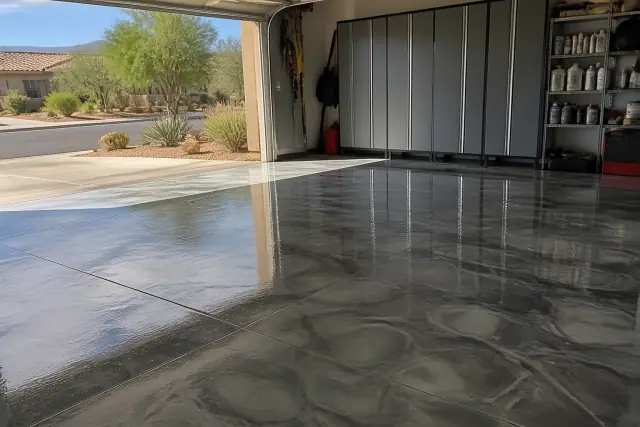
Metallic Garage Flooring

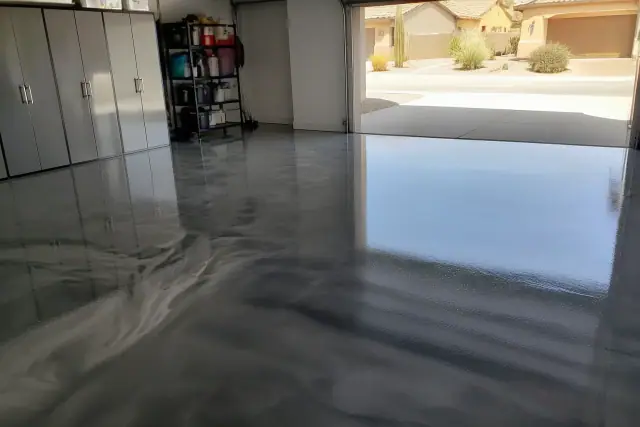
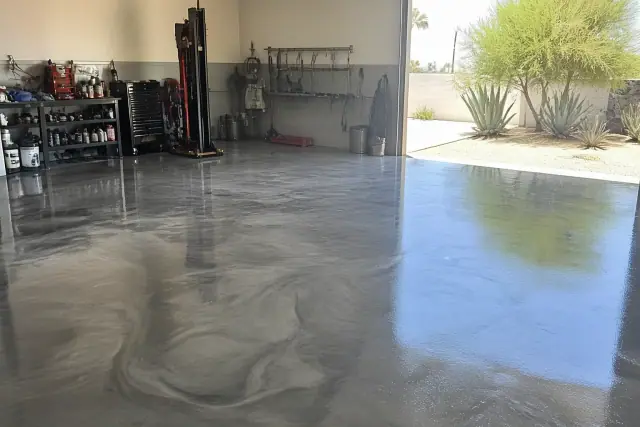
Metallic epoxy flooring with an iridescent finish in a residential garage in Phoenix, AZ.

A standard two-car garage in the Valley runs 400-500 square feet and faces vehicle weight, oil, coolant, and desert dust. On 115-degree afternoons, asphalt-softened tires can pull at poorly bonded coatings, so a diamond-ground metallic system with a compatible topcoat is designed to resist hot tire pickup.

Request Estimate

Kitchen and Interior Epoxy Floors

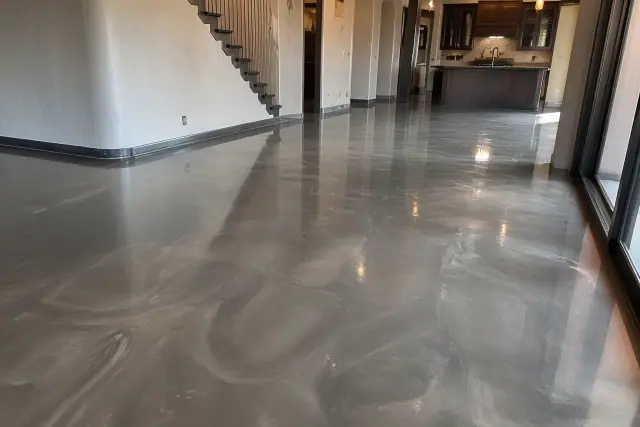
Metallic epoxy flooring with swirling pigments in a sunlit open-concept kitchen in Phoenix, AZ.

Phoenix kitchens, mudrooms, and sunrooms can use liquid epoxy flooring for a grout-free surface that handles foot traffic and moisture without tile maintenance. Metallic pigments add movement and depth while the continuous coating keeps the finished floor seamless.

Request Estimate

Retail and Showroom Metallic Floors

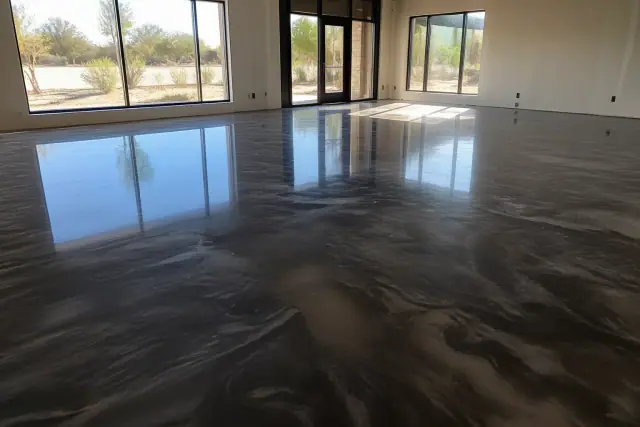
High-gloss metallic epoxy flooring in a retail showroom space in Phoenix, AZ.

Metallic epoxy is well suited to retail showrooms and other presentation-focused commercial spaces. A high-gloss topcoat reflects ambient light through the pigment, while the seamless surface avoids joints that can trap grit during routine cleaning.

Request Estimate

Warehouse and Industrial Epoxy

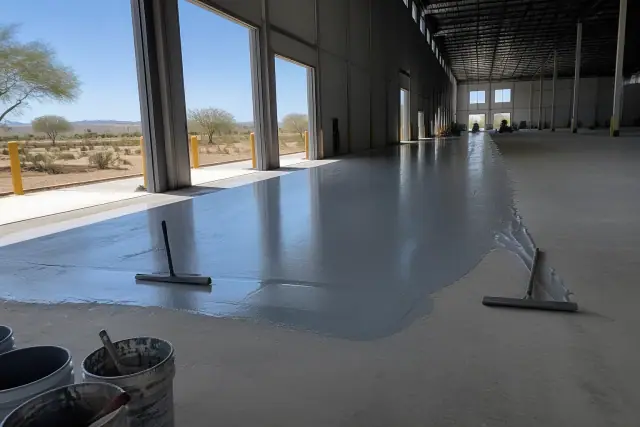
Liquid epoxy poured on a warehouse floor with tools nearby during surface preparation in Phoenix, AZ.

Warehouses along the I-10 and Loop 202 corridors need coatings built for forklift traffic, pallet-jack abrasion, and chemical spills. These systems are often specified at 20-40 mils with silica or quartz broadcast for slip resistance aligned with ADA and OSHA walking-surface requirements, and polyaspartic topcoats can support reopening in as little as 24 hours rather than the several days associated with standard epoxy.

Request Estimate

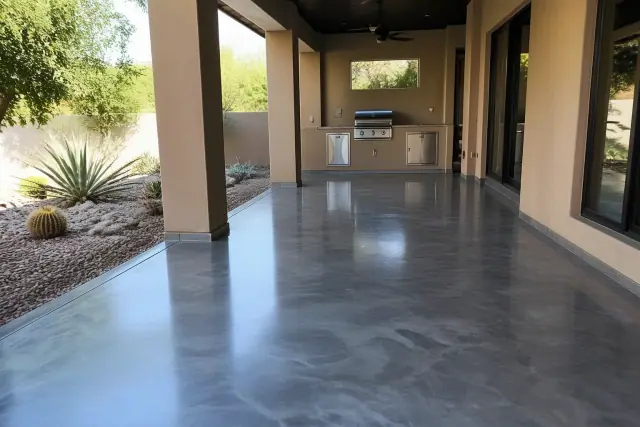
Outdoor Patios and Covered Walkways

Metallic epoxy flooring on a covered outdoor patio with desert landscaping in Phoenix, AZ.

Metallic epoxy can be installed on Phoenix patios and covered walkways when the slab, drainage, slope, and sun exposure are suitable. Outdoor work requires a UV-stable polyaspartic topcoat because standard epoxy can yellow and chalk under direct Arizona sunlight.

Request Estimate

Polyaspartic Topcoat Systems

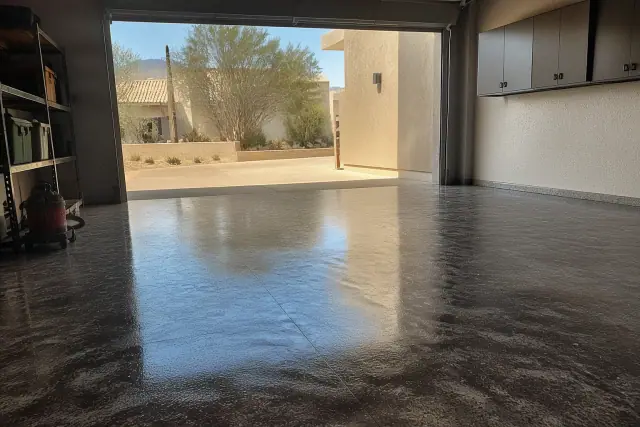
Glossy polyaspartic topcoat finish on a residential garage floor in Phoenix, AZ.

Polyaspartic coatings serve as UV-stable topcoats over metallic and flake floors and can also form standalone one- and two-day garage systems. They tolerate Phoenix temperature swings better than standard polyurethane, cure in hours rather than days, and often reach full cure within 24 to 72 hours.

Request Estimate
Design and Finish Choices

Metallic Epoxy Design Options

No two metallic pours look identical. Color selection, base tint, pigment ratios, manipulation method, topcoat sheen, and optional flake texture can produce effects ranging from broad liquid movement to focused veins and stone-like depth.

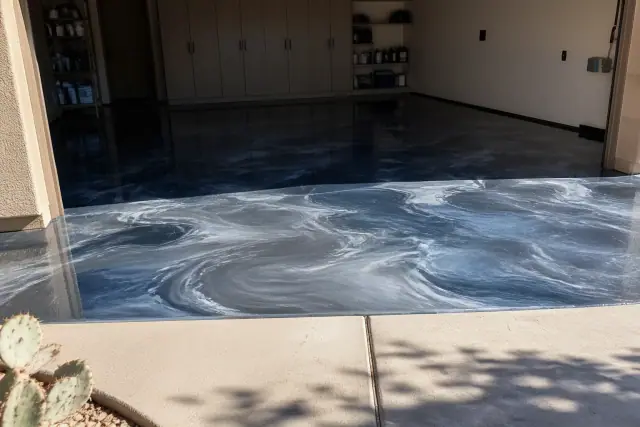
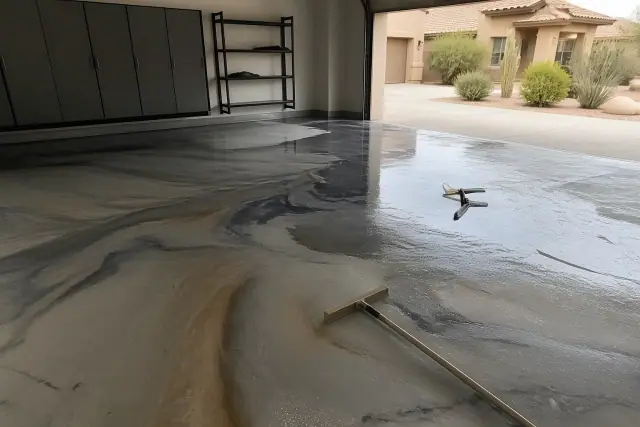
Freshly applied metallic epoxy flooring with swirling patterns in a Phoenix, AZ residential garage.

Ocean-Wave Metallic Patterns

Ocean-wave effects use layered pigment colors and directional movement to create broad, flowing bands across the floor. The installer shapes the composition while the resin remains open, preserving movement without turning the surface into a repeated printed pattern.

  • Multiple pigment colors layered in one pour
  • Squeegee and roller movement for broad bands
  • Compressed air for softer pigment transitions
  • High-gloss topcoat to emphasize liquid depth
  • A unique pattern created by each installation
Request Estimate
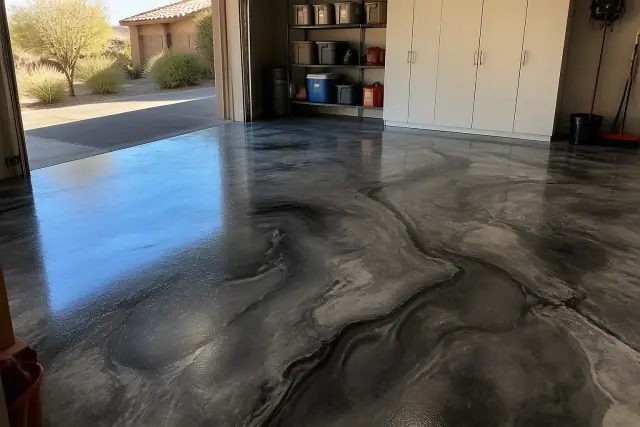
Metallic epoxy flooring with lava-flow veining in a residential garage in Phoenix, AZ.

Lava-Flow Veining

Lava-flow designs concentrate pigment into dramatic veins and contrasting fields. Controlled movement with trowels, squeegees, a torch, or an air blower develops the visual flow while also helping release surface bubbles before gel time.

  • Focused veins with contrasting pigment fields
  • Mica or metallic mineral pigment movement
  • Clear or tinted base-resin choices
  • Surface manipulation during the open working window
  • Bubble control before the resin gels
Request Estimate
Metallic epoxy floor with marbled silver and charcoal swirls in a vehicle service bay in Phoenix, AZ.

Marbled Stone Effects

Marbled metallic floors use layered color and selective veining to echo the depth of stone without introducing tile joints. The effect can suit modern homes, luxury garages, and showrooms where the floor is part of the overall design.

  • Layered color for stone-like visual depth
  • Selective veining rather than uniform broadcast
  • Seamless coverage without grout lines
  • Viewing-angle changes under ambient light
  • Suitable for garages, interiors, and showrooms
Request Estimate
Metallic epoxy flooring installation in progress inside a residential garage in Phoenix, AZ.

Custom Colors and Sheen

Custom color blends can coordinate with HOA-approved exterior palettes or interior design schemes. Topcoat sheen is selected alongside appearance and slip-resistance needs so the final surface fits both the space and how people move through it.

  • Custom pigment blends
  • Satin topcoat option
  • Semi-gloss topcoat option
  • High-gloss topcoat option
  • Sheen selected with slip resistance in mind
Request Estimate
Metallic and flake hybrid epoxy flooring in a residential garage in Phoenix, AZ.

Metallic-and-Flake Hybrid Floors

A hybrid floor places a light flake broadcast beneath a metallic topcoat, combining texture with metallic shimmer. This approach is common in Phoenix showrooms and luxury garages where clients want extra visual depth along with a more textured finish.

  • Light flake broadcast below the metallic layer
  • Added texture beneath metallic shimmer
  • Greater visual depth than a uniform finish
  • A practical option for showroom floors
  • A distinctive choice for luxury garages
Request Estimate
Planning for Phoenix Slabs

Choosing the Right Metallic Epoxy Approach

A durable metallic floor begins with the slab rather than the color chart. Surface profile, moisture, cracks, old coatings, sun exposure, traffic, chemical contact, design complexity, and available downtime all influence the preparation, resin build, pigment plan, and topcoat.

Diamond-Ground Surface Preparation

Mechanical diamond grinding opens the concrete pore structure and removes laitance, oil staining, and old paint. We target ICRI CSP 3 for standard epoxy and CSP 4-5 for metallic and polyaspartic systems instead of substituting acid etching for a bond-ready profile.

Moisture Testing and Mitigation

Phoenix slab-on-grade construction can carry moisture vapor that compromises adhesion beneath an otherwise sound coating. Calcium chloride readings help identify high-moisture slabs so mitigation can be included before the decorative system is applied.

UV-Stable Polyaspartic Protection

A UV-stable polyaspartic topcoat helps metallic color and gloss hold up under direct Arizona sun. Standard polyurethane can yellow within a couple of seasons in exposed applications, so topcoat selection must reflect the floor's actual sun exposure.

What Sets Us Apart

Why Phoenix Epoxy Co. for Metallic Epoxy Flooring?

Projects begin with an on-site slab inspection and a clear discussion of system type, preparation, pigment complexity, topcoat, traffic, and cure timing. Phoenix-specific steps such as mechanical profiling, moisture evaluation, early-morning or shaded pours, and UV-stable protection address the conditions that most often undermine coating performance.

Request Slab Assessment

Hot Tire Pickup

Heat-softened tires can pull at coatings that lack a strong mechanical bond to the slab. Proper grinding and a compatible epoxy or polyaspartic system reduce this common garage-floor failure point.

Peeling and Delamination

Peeling often traces back to inadequate profiling, remaining laitance, oil contamination, or old paint beneath the system. Mechanical grinding removes weak surface material and gives the resin the profile it needs to bond.

Moisture Vapor Beneath the Coating

Moisture moving through a slab can weaken adhesion and create early coating failure. Testing informs whether vapor mitigation belongs beneath the metallic system rather than leaving that risk hidden.

Bubbles and Slab Outgassing

Porous or previously uncoated concrete can release air as resin cures, creating pinholes or bubbles. Installers control application conditions and use a torch or air blower during the working window to release surface bubbles before gel.

UV Yellowing and Chalking

Standard epoxy and polyurethane can discolor or chalk under direct Arizona sun. Exposed patios, walkways, and sunlit floors need a UV-stable polyaspartic topcoat selected for that exposure.

Flash Curing and Uneven Pigment

Phoenix heat accelerates epoxy chemistry and can close the working window before pigment and bubbles are properly managed. Early-morning or shaded pours help prevent flash curing, trapped bubbles, trowel marks, and uneven pigment distribution.

How It Works

Our Metallic Epoxy Installation Process

Each stage prepares the next, from slab evaluation through controlled cure. Skipping inspection, profiling, repair, moisture planning, or application control can compromise both the design and the bond.

01.

Inspect and Test the Slab

We inspect square footage, cracks, stains, existing coatings, drainage, slope, sun exposure, and traffic. Moisture testing, including calcium chloride readings when appropriate, helps define the system before quoting.

02.

Diamond Grind the Concrete

Mechanical diamond grinding removes weak surface material and opens the concrete pores. Metallic and polyaspartic work is prepared to the deeper ICRI CSP 4-5 profile described for these systems.

03.

Repair and Mitigate

Cracks, peeling paint, and old coatings are addressed before the decorative pour. If testing shows elevated slab moisture, vapor mitigation is incorporated rather than coating over the condition.

04.

Batch Resin and Pigments

The 100% solids resin and pigment colors are batched at controlled ratios for the selected design. Batch size and slab temperature are managed so crews have enough open time to place and shape the material.

05.

Pour, Shape, and Release Bubbles

Resin is poured in sections and moved with trowels, squeegees, rollers, compressed air, or a torch. The same working window is used to develop swirls and veining while releasing surface bubbles.

06.

Topcoat and Protect the Cure

The selected UV-stable polyaspartic topcoat protects the metallic layer while the floor follows a staged cure. Foot traffic is typically safe in 24 hours, vehicle traffic in 3-5 days, and full chemical cure within 7 days, with faster cure possible for polyaspartic topcoats.

Plan Your Floor

Schedule a Metallic Epoxy Flooring
Consultation

Tell us where the floor is located, how the space is used, and the look you want. We will inspect the slab on site, review preparation and system options, and provide a quote based on its actual condition.

Metallic Floor Help

Metallic Epoxy Flooring FAQs

Review the practical details behind metallic epoxy pricing, preparation, design, cure time, maintenance expectations, and outdoor use in Phoenix. For a project-specific answer, the slab still needs an on-site inspection.

Call Phoenix Epoxy Co.

Metallic epoxy in the Phoenix market typically runs $7 to $15 per square foot installed, and a standard 400-500-square-foot two-car garage commonly falls between $4,000 and $7,000. Standard flake systems run roughly $4 to $7 per square foot, with common two-car-garage totals of $2,500 to $3,500, while solid-color coatings commonly total $2,000 to $3,000. Polyaspartic-only systems are in a similar per-square-foot range to flake, and commercial or industrial systems can reach $7 to $12 or more per square foot as mil thickness and traffic requirements rise. An exact quote depends on slab moisture, repairs, coating removal, pigment complexity, and topcoat selection.

Metallic epoxy costs more upfront than standard flake or solid-color coatings and requires skilled pigment manipulation during a narrow working window. Results vary with installer technique, and exact pattern replication or isolated touch-ups are harder because each pour is unique. Rushed preparation or application can also leave trowel marks, uneven pigment, or bubbles.

It can be worthwhile when a garage functions as living space or a showroom needs a distinctive, high-impact floor. Metallic epoxy adds visual depth and design flexibility that flake and solid-color systems do not match. Buyers focused on the lowest-cost durable finish may be better served by flake or polyaspartic options.

With professional installation and routine care, metallic epoxy flooring typically lasts 10 to 20 years or more. Longevity depends heavily on mechanical surface preparation, slab moisture, traffic, chemical exposure, and the topcoat. A UV-stable polyaspartic topcoat is especially important for direct-sun Phoenix applications.

A properly installed metallic floor should not contain trapped bubbles, although minor pinholing can occur when porous concrete outgasses during cure. Installers use a torch or air blower before the resin gels to release surface bubbles. Excessive bubbling can indicate poor preparation, slab moisture, or unsuitable application temperatures.

A professional quote accounts for square footage, grinding equipment, material use and waste, pigment complexity, topcoat choice, crack repair, moisture mitigation, and removal of existing coatings. Metallic patterns also require more application time than flake or solid-color systems. Phoenix Epoxy Co. bases the quote on the slab's inspected condition rather than a flat estimate alone.

Yes, it can be used on suitable patios and covered walkways when drainage, slope, and slab condition are evaluated first. Outdoor installations require a UV-stable polyaspartic topcoat because standard epoxy can yellow and chalk in direct Arizona sun. Standing water must also be considered because it can affect coating and slab longevity.

Diamond grinding opens the concrete pore structure and removes laitance, oil staining, old paint, and other weak surface material. Metallic and polyaspartic systems are prepared to an ICRI CSP 4-5 profile, while standard epoxy targets CSP 3. Acid etching does not provide the same controlled mechanical profile.

Cure time depends on slab temperature and the selected topcoat. Foot traffic is typically safe in 24 hours, vehicle traffic in 3-5 days, and full chemical cure occurs within 7 days. Polyaspartic topcoats can cure faster.

Metallic epoxy suspends pigment through a full-depth resin pour, producing seamless swirls and visual depth. Flake flooring uses broadcast aggregate to hide scuffing and add texture or slip resistance in busy areas. Metallic is the premium design choice, while flake can be the more budget-focused durable option.

Polyaspartic provides a UV-stable protective layer over the metallic design and tolerates Phoenix temperature swings better than standard polyurethane. It cures in hours rather than days and helps protect color and gloss in direct sun. It is also used as a standalone garage-floor system.

Supported applications include garages, kitchens, mudrooms, sunrooms, warehouses, retail showrooms, patios, and covered walkways. The right build depends on vehicle or foot traffic, chemical exposure, sunlight, moisture, drainage, and required slip resistance. The slab must be inspected before a system is selected.

Metallic pigments can be shaped into ocean-wave movement, lava-flow veining, marbled stone effects, or custom blended designs. Colors can coordinate with interior schemes or HOA-approved exterior palettes. Satin, semi-gloss, and high-gloss topcoats adjust the final sheen, and a light flake broadcast can add texture beneath metallic shimmer.