Typical Installed Range
The usual installed range is $4 to $8 per square foot. Standard industrial material alone may start around $2.00 to $2.50 per square foot, while heavy-duty systems can bring the installed total to $7 to $12 per square foot.
At Phoenix Epoxy Co., industrial epoxy flooring in Phoenix typically costs $4 to $8 per square foot installed, while heavy-duty systems can reach $7 to $12+ per square foot. The final figure depends on slab preparation, coating type, floor area, traffic, and finish, so the lowest advertised rate rarely tells the whole story.
The usual installed range is $4 to $8 per square foot. Standard industrial material alone may start around $2.00 to $2.50 per square foot, while heavy-duty systems can bring the installed total to $7 to $12 per square foot.
A quote combines coating materials, grinding and repairs, labor, coat count, and finish. Oil staining, cracks, or an older slab can make preparation the largest variable before any coating goes down.
Water-based epoxy at $2 to $4 per square foot suits lighter use; solvent-based epoxy at $4 to $7 handles moderate traffic; and polyaspartic at $5 to $8 offers faster curing and better resistance to UV yellowing.
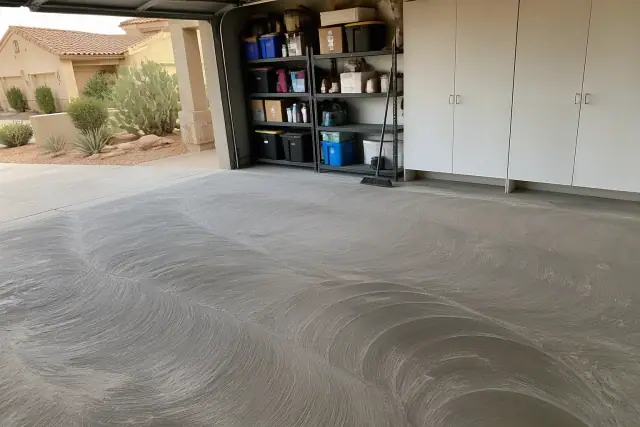
Diamond grinding on an older, cracked, or oil-stained industrial slab. Buildings near I-17 and Loop 202 may require extra work to achieve the proper concrete surface profile.
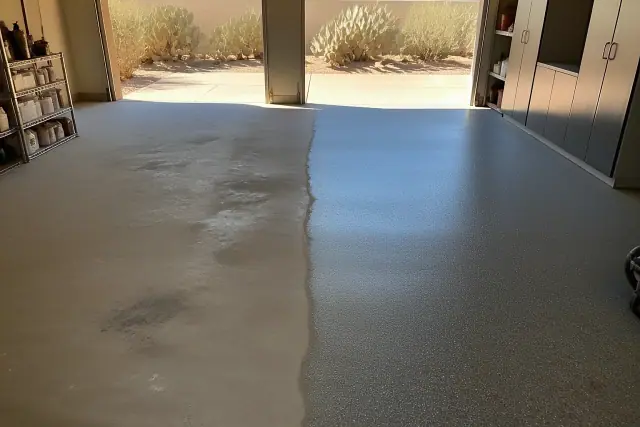
Compare a single high-build coat at $3 to $6 per square foot with a basecoat-and-topcoat system at $5 to $9. The two-coat build costs more but provides better wear resistance, chemical resistance, and color depth.
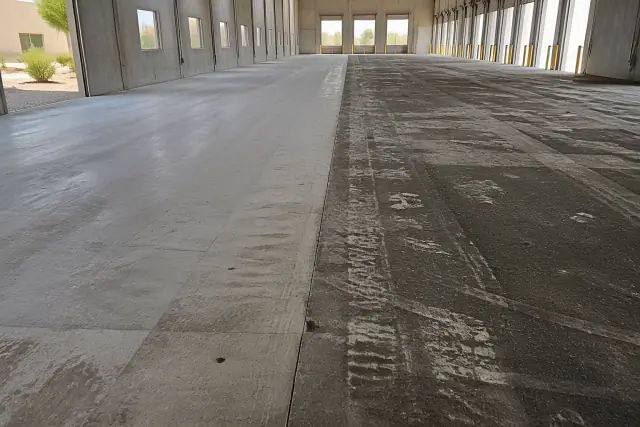
The difference between a lightly used residential floor and a warehouse aisle carrying daily forklift traffic. Traffic, chemical exposure, abrasion, and point loads determine whether a basic or heavy-duty system is appropriate.
Basic Phoenix garage coatings generally run $5 to $7 per square foot, and a standard two-car garage often totals $2,000 to $3,500. Professional quotes for a typical 400 to 600 square foot garage may reach $4,000 to $5,500 as slab and system demands rise, while residential epoxy overall runs $4 to $9 per square foot.
Phoenix commercial flooring spans $3 to $12 per square foot, with many restaurant kitchen, retail, and office jobs at $5 to $8. Setup and mobilization spread farther on large floors, so a 20,000 square foot warehouse may cost less per square foot than a 500 square foot shop.
Decorative flake systems run $6 to $9 per square foot. Metallic epoxy averages $7 to $9, specialized multi-color pours can reach $12 or more, and custom finishes or logo work can add $2 to $5 per square foot over a basic solid color.
Grind-and-seal systems cost $2 to $5 per square foot, while tile installation frequently exceeds $10 to $15 after material, grout, membrane, and labor. Bare concrete costs less upfront, and vinyl may price near epoxy, but neither offers the same protection against industrial dusting, spills, abrasion, and heavy point loads.
| Flooring system | Typical cost per sq ft | Common fit |
|---|---|---|
| Water-based epoxy | $2-$4 | Light residential and low-traffic areas |
| Solvent-based epoxy | $4-$7 | Garages, retail, and moderate traffic |
| Solid-color industrial epoxy | $4-$8 | Warehouses and factory floors |
| Polyaspartic coating | $5-$8 | Fast-turnaround commercial work and sun exposure |
| Decorative flake system | $6-$9 | Garages needing texture and concealed slab variation |
| Metallic epoxy | $7-$12+ | Showrooms, lobbies, and upscale interiors |
Start with measured floor area, then account for slab condition, traffic, system type, finish, and coat count. Epoxy resin and hardener can cost $1.45 to $6 per square foot depending on solids content and additives, including 100% solids systems, while installation labor runs $3 to $9. Coverage of 150 to 200 square feet per gallon per coat also changes the material total based on substrate porosity and the number of coats.
DIY materials may cost $1 to $4 per square foot, but savings disappear if mixing, moisture testing, concrete surface profile grinding, or mil thickness is wrong. Skipped preparation can lead to peeling, bubbling, or delamination within the first year, while proper installation can separate a floor that lasts about 15 years from one that fails within months. Phoenix loading docks and south-facing bays may also justify polyaspartic coatings, which cure in hours rather than days and resist UV yellowing better than standard epoxy.
Is epoxy cheaper than tile or bare concrete? Bare concrete wins on initial price, but epoxy is usually below a complete tile installation and better controls dusting, staining, and wear. Is polyaspartic worth the premium? Its $5 to $8 per square foot range can make sense when a commercial floor needs a faster return to service or better UV stability. Can DIY lower the bill? Material costs may be lower, but moisture testing, grinding, mixing ratios, and coat thickness remain critical to avoiding early failure.
Share the floor size, property use, finish, and known slab concerns. A site-specific estimate can account for grinding, moisture conditions, coat count, slip resistance, and the required cure window before the work is scoped.