Typical Installed Range
Most one- or two-car garage projects fall between $1,200 and $4,500, with the final number tied to floor area, coating choice, and slab preparation.
Phoenix Epoxy Co. explains why most Phoenix homeowners pay between $1,200 and $4,500 to epoxy a standard one- or two-car garage floor. Professional installation generally runs $4 to $9 per square foot, depending on the coating system and the concrete's condition.
Most one- or two-car garage projects fall between $1,200 and $4,500, with the final number tied to floor area, coating choice, and slab preparation.
Garage size, concrete condition, coating system, number of coats, and decorative flake or metallic pigment determine where a project lands within the range.
Measure the floor and inspect cracks, spalling, oil stains, moisture, and old sealers before comparing quotes; these conditions determine the grinding and repair scope.
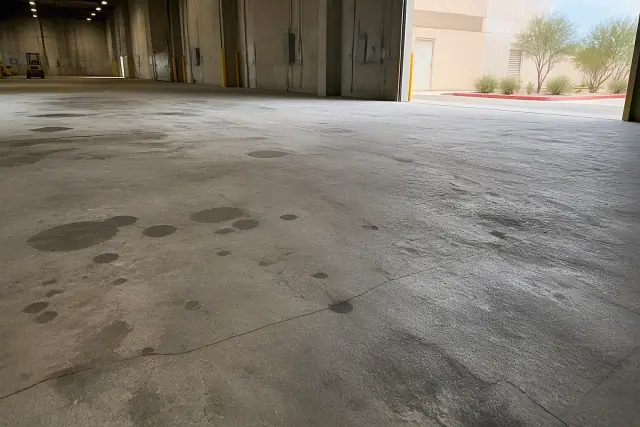
The cracks, spalling, and oil staining that make an older slab, such as one in a 1970s Maryvale home, more expensive to prepare than a clean new pour in Verrado.
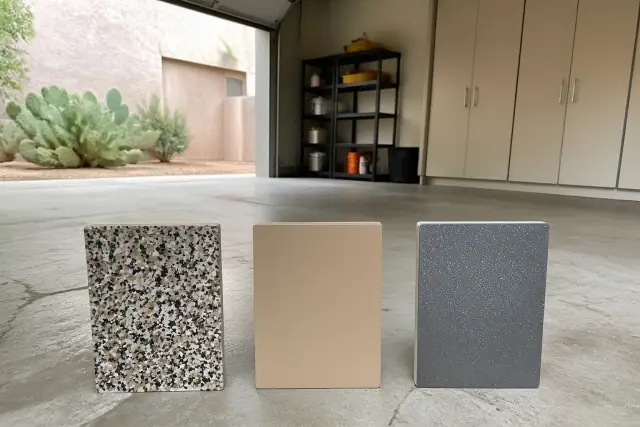
The practical visual difference between a broadcast flake floor, an affordable solid-color coating, and a labor-intensive marbled metallic finish.
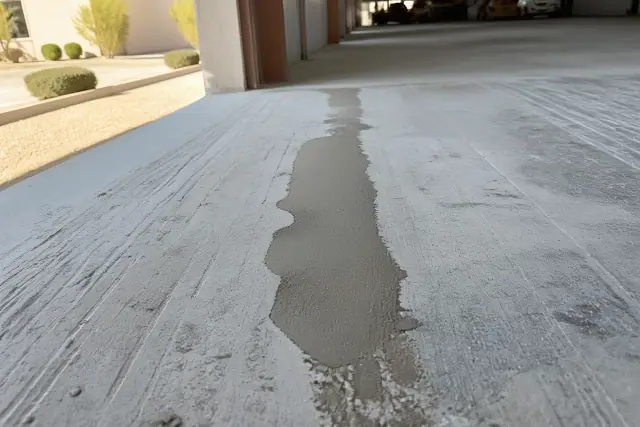
Mechanical grinding opening the concrete pores and repaired cracks or control joints before primer and base coat application.
A typical two-car flake system costs $1,800 to $4,000, with standard installations generally priced at $4 to $7 per square foot.
A basic grind-and-seal or solid-color coating is the lower-cost professional option, often $2,000 to $3,000 for a two-car garage because it uses fewer coats and skips decorative flake.
A multi-color, marbled metallic floor runs $4,000 to $7,000 for a standard two-car garage because the pigment technique requires a more labor-intensive, multi-layer application.
Mid-grade polyaspartic builds generally run $8 to $12 per square foot, while high-performance or heavily decorative systems can reach $8 to $20+ per square foot depending on build thickness.
| Garage Size | Square Feet | Material Cost | Labor Cost | Total Range |
|---|---|---|---|---|
| 1-car | 200-250 | $400-$1,500 | $800-$2,250 | $900-$1,800 |
| 2-car | 400-480 | $800-$2,880 | $1,600-$4,320 | $1,800-$4,000 |
| 3-car | 600-720 | $1,200-$4,320 | $2,400-$6,480 | $2,700-$6,000 |
A complete quote can include surface preparation, primer, base coat, decorative flake or metallic pigment, and a topcoat sealer. Materials generally account for $2 to $6 per square foot, while labor runs $4 to $9 because diamond grinding, repairs, and multi-coat application require time and equipment. Across the Phoenix metro, smaller garages often land between $1,200 and $2,400, while a full two-car flake installation commonly runs $2,500 to $3,500. Standard systems typically use two to three coats, and commercial-grade 100% solids epoxy costs more than water-based epoxy while providing stronger abrasion and hot-tire resistance.
Garage size, slab condition, coating system, number of coats, decorative finish, and preparation requirements all move the final price. Older slabs in Arcadia and Encanto can require different preparation than new-construction garages in Ahwatukee and North Phoenix, while a cracked, oil-stained slab in a 1970s Maryvale home needs more work than a clean new pour in Verrado. Phoenix's intense summer sun, high slab temperatures, and low humidity shorten working times; UV-stable polyaspartic coatings cure faster than traditional epoxy and can reduce installation downtime. Cracks, spalling, moisture issues, heavily sealed concrete, and damaged control joints increase the grinding, patching, and mitigation needed before primer, base coat, broadcast, and topcoat.
For a 20x20 garage, 400 square feet of standard flake epoxy typically costs $1,600 to $3,200 at $4 to $8 per square foot installed. A DIY kit for roughly 500 square feet costs $300 to $500 in materials alone, but it lacks the mechanical diamond grinding, controlled mil thickness, and adhesion warranty described for professional installation. Epoxy can be slippery when wet without a slip-resistant additive, and poor preparation or untreated moisture vapor can lead to peeling, bubbling, or white haze. A properly installed epoxy or polyaspartic system can last 10 to 20 years with normal residential use, while improper surface preparation is the leading cause of early failure.
Share the garage size, slab condition, and preferred finish to request a free quote after an on-site inspection. Ask for preparation, repairs, coating layers, and topcoat to be itemized so every estimate reflects the same scope. The team states it carries the licensing and insurance required for residential and commercial contract work in Maricopa County.